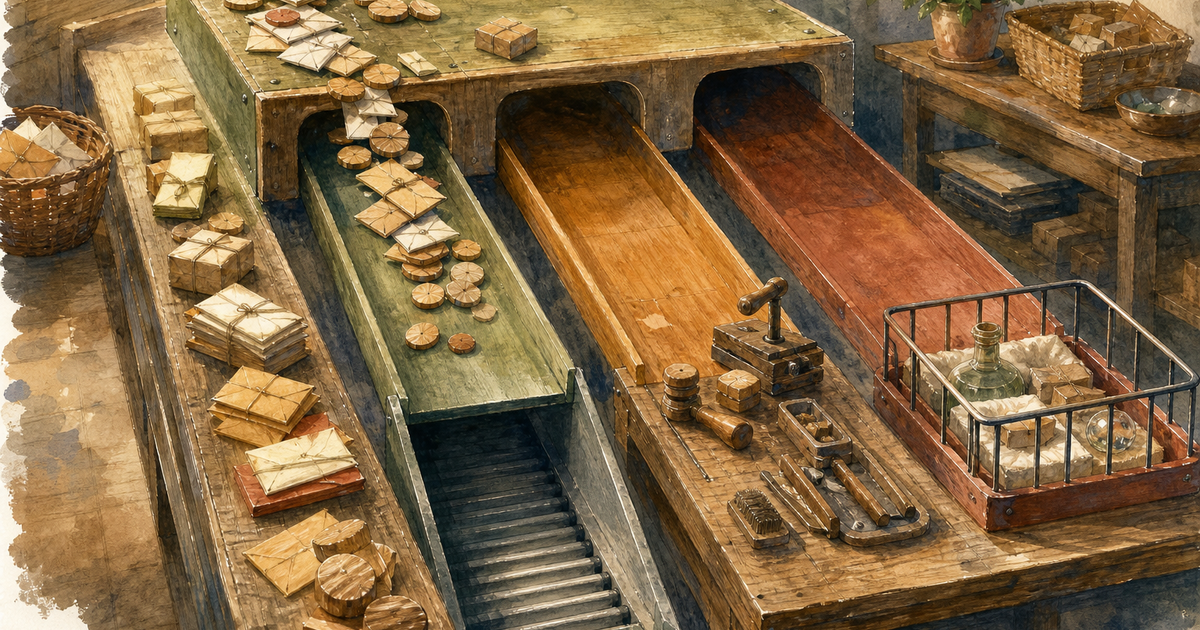
The first business task to automate should offer a strong learning-to-risk tradeoff: it happens often, follows a visible process, produces a checkable result, and can fail without damaging the business. Do not begin with the task that costs the most. Begin with the task that can prove the operating model safely.
Last updated: July 24, 2026
Key Takeaways
- Choose the first automation by readiness, impact, and failure cost—not by annoyance alone.
- Prefer frequent work with stable inputs, explicit success criteria, and a reversible outcome.
- Use deterministic rules when the path is known; use an agent only when the work needs interpretation.
- Withhold unnecessary permissions during the pilot.
- Name one pilot and one explicit non-candidate so the decision has a boundary.
Is the task repeatable and observable enough to test?
A good first candidate leaves evidence. You can see when it starts, inspect what it produced, and compare that result with a known standard. Weekly report assembly, lead enrichment, or content inventory may qualify if the inputs and outputs are stable. “Help with marketing” does not.
OpenAI’s workspace-agent guidance describes repeatable, structured, triggered, tool-based work as a practical starting profile. One-off exploration may be useful in ordinary chat, but it does not give an operator the same repeatable system to evaluate.
Start by writing the workflow as a single sentence: “When this input arrives, produce this result, using these sources, before this deadline.” If that sentence cannot be made concrete, document the process before automating it.
Can success and failure be judged from a concrete output?
Automation readiness depends on an acceptance test. A report might pass when all required sources are present, totals reconcile, and exceptions are listed. A research brief might pass when every claim has a direct source and prohibited topics are absent. “Looks good” is not yet an operational test.
The broader DGP article on what works with AI agents shows why painful repetition alone is insufficient: the workflow still needs defined boundaries and review. The solopreneur blueprint places automation inside an accountable operating structure rather than treating it as a collection of shortcuts. DGP’s AI-stack case study is another operation-specific example, not a universal task ranking.
| Readiness signal | Ask | Score |
|---|---|---|
| Frequency | Does the same trigger occur often enough to learn from? | Low / Medium / High |
| Documentation | Are inputs, steps, exceptions, and outputs written down? | Low / Medium / High |
| Detectability | Will a wrong, late, or duplicate result be noticed? | Low / Medium / High |
| Reversibility | Can the result be corrected before it affects customers or money? | Low / Medium / High |
| Access risk | Can the pilot run with read-only or narrowly scoped tools? | Low / Medium / High |
What happens if the automation is wrong, delayed, or duplicated?
Trace the failure before selecting the tool. A wrong internal draft may create rework. A duplicated customer message may damage trust. A delayed inventory alert may affect purchasing. Those are different risk shapes and should not receive the same permissions.
NIST’s AI Risk Management Framework Core calls for context to be mapped and risk to be measured and prioritized by impact, likelihood, and available resources. For a first pilot, the practical translation is simple: favor errors that are visible, containable, and reversible.
Does the work require an agent or a deterministic workflow?
Use a deterministic workflow when the path can be expressed as stable rules. Use an agent when the workflow needs to interpret unstructured input, apply judgment within a defined boundary, or select among tools. Adding an agent to a known rules engine introduces variability without necessarily adding value.
OpenAI’s agent-building guide distinguishes workflows that benefit from model judgment from those where a deterministic solution may be sufficient. The correct first automation may be a conventional trigger-and-action flow with no model at all.
Which permissions can be withheld during the pilot?
Start with the smallest useful permission set. Let the system read a limited source, write to a staging location, and prepare a recommendation. Keep publishing, deletion, spending, account changes, and customer communication behind a human approval.
Make a shortlist of three tasks, score them with the table, and choose one pilot. Then record one non-candidate and why it is excluded. This prevents the pilot from quietly expanding into risky adjacent work.
If the first pilot cannot produce a reliable result with narrow permissions and clear review, improve the process definition before increasing autonomy. That lesson is valuable even if the automation never ships.
Frequently Asked Questions
What is the best first business task to automate?
The best first task is frequent, documented, easy to observe, and safe to reverse. Its output should have a concrete acceptance test, and the pilot should run with limited permissions.
Should an operator automate the most expensive task first?
Not automatically. A high-cost task may also carry high exception rates or failure impact. The first pilot should balance useful learning with contained risk.
When should a business use rules instead of an AI agent?
Use deterministic rules when inputs and paths are stable and known. An agent is more appropriate when bounded interpretation of unstructured information is genuinely required.
How many tasks should the first automation pilot include?
One clearly bounded workflow is enough. Keeping the pilot narrow makes quality, rework, permissions, and failure handling easier to measure.
Choose your pilot with a working scorecard: Download The Agent Army Bonus Pack.
Then build the operating structure around it with The Agent Army.